
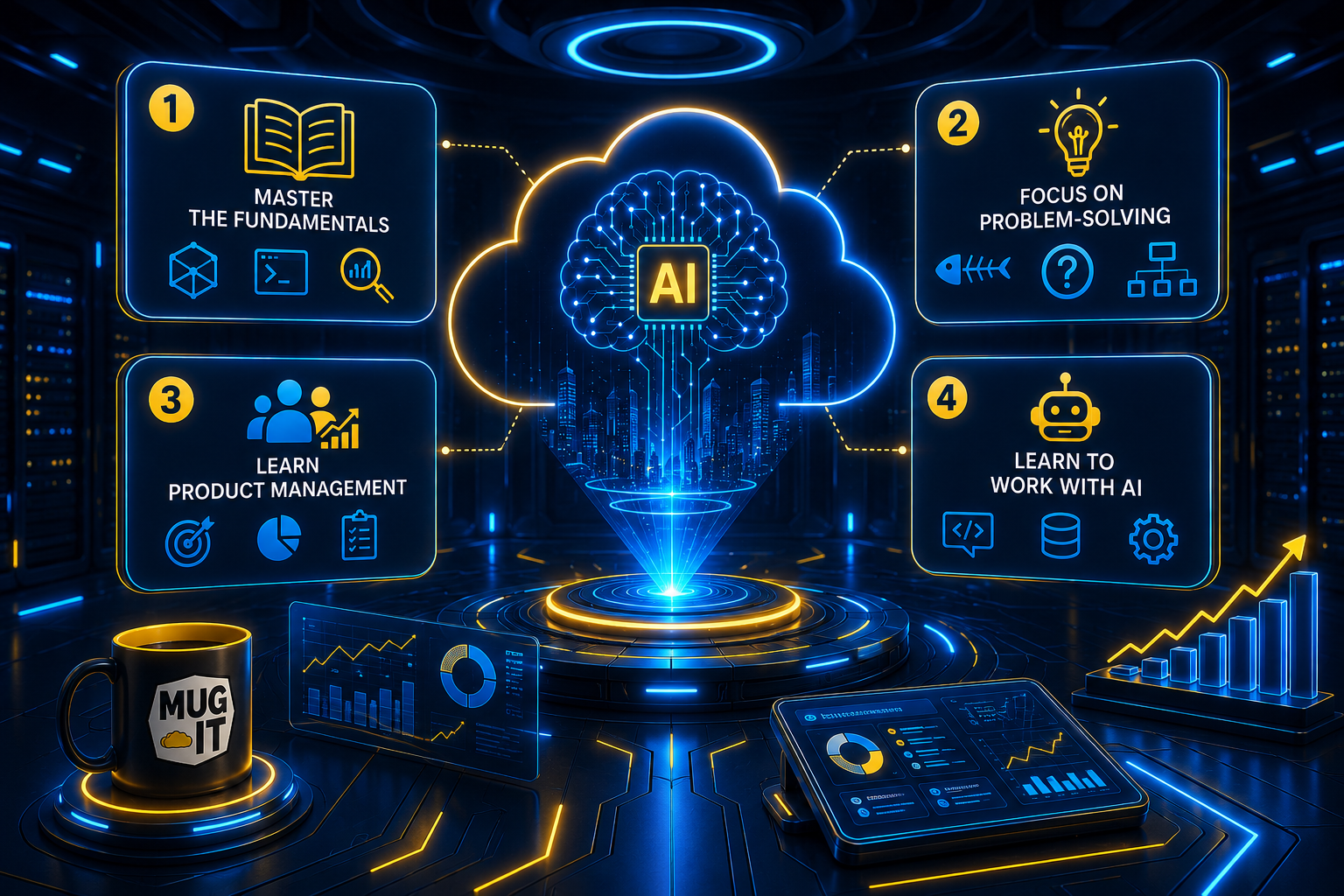
4 Ideas to Stay Relevant as an Engineer in the AI Era
Hey everyone. Today I want to share four things I’ve been doing myself, and honestly, four things I believe engineers at the Senior, Staff, and Principal level should be doing to stay relevant even as AI reshapes how we work.
Let’s be real about the moment we’re in. Staying relevant has always been hard in tech, because tech changes constantly. But we’re no longer talking about linear change. The next few years will bring growth that’s disproportionate, almost explosive. So the way we think about our careers has to shift too.
Here’s where I’d put my energy.
1. Master the Fundamentals
We in tech always loved saying things like “it’s easy to talk, show me how you do it in practice” or “I only learn by doing.” I think it’s time to retire that mindset.
Why? Because you’ll rarely sit down and do the raw work anymore. And if the AI is doing it, then… it’s not really you, is it? So “I only learn by doing” quietly stops being true.
But that doesn’t mean fundamentals matter less. It means they matter more. The goal now is to become a super generalist with real depth in how the fundamentals actually work. You don’t need to memorize every implementation detail. But if you deeply understand architecture, operations, and observability, you’ll rarely fail hard.
So next time you read a piece of content, don’t just consume it, interrogate it:
- Why was this built this way?
- How should it have been done?
- Is it resilient?
- How would I apply observability here?
- Are there automated tests?
- How would I deploy all of this without affecting my users?
That last set of questions? That’s pure SRE thinking. Simplicidade, resilience, and observability aren’t features you bolt on, they’re the lens you read everything through.
2. Focus on Problem-Solving
If you know your fundamentals and you know how to solve problems, you stay relevant. Full stop.
Knowing where to look and what to ask has always been a high-demand skill. It’s even more valuable now, because much of our job is guiding what I’d call a very capable “AI junior operator.” The AI has a solid harness, but it still needs you to know how to think and where to point it.
This is exactly why structured problem-solving frameworks are having a comeback:
- The 5 Whys to get past symptoms and find root cause
- Fishbone (Ishikawa) diagrams to map contributing factors
- Hypothesis-driven investigation instead of random guessing
- Issue trees to break a messy problem into solvable branches
From an SRE angle, this is incident response and debugging done right. The engineers who thrive won’t be the ones who type the fastest, they’ll be the ones who frame the problem correctly and direct the tooling (human or AI) toward the real answer.
3. Learn Product Management
Here’s the uncomfortable question: if everyone can build now, how do you make sure you’re building something that’s actually needed? We’re shipping features but not value!! (BTW, this was already common before, but now it’s almost the rule haha)
I’ll never forget the first time I learned about Design Thinking. It completely changed how I aligned features to real customer needs instead of just shipping what was technically interesting. That skill went from “nice to have” to essential.
Learn to identify customer problems, prioritize what actually matters, measure outcomes, and connect technical decisions back to business value. And just as importantly, learn to communicate the product: present it, share the know-how, tell the story.
This ties straight into SRE too. SLOs are a product conversation. Reliability is a feature you negotiate with the business, “how reliable does this need to be, and what does that cost us?” A Senior engineer who can speak both the technical and the product language, and who can structure their agents to execute against that, becomes very hard to replace.
4. Learn to Work With AI
Stay current, but be picky about what you stay current on. Don’t chase every new LLM launch or benchmark that fixes nothing. Chase the fundamentals of the tooling instead:
- What is a harness, and how do I improve mine?
- How do I build better, more focused agents?
- How do I automatically feed my agents historical context so they get smarter over time?
- How do I encode my method and way of thinking into a workflow?
- How do I optimize token usage and manage the context window?
This is where it gets fun for us. Automating your own workflow is basically eliminating toil, the most SRE thing there is. Every repetitive task you hand to a well-built agent is time you reclaim for systems thinking and higher-leverage work. Treat your agents like production systems: give them good inputs, observe their output, and iterate.
The Takeaway
Staying relevant has always been our challenge in technology. But the increase we’re facing now isn’t linear, it’s steep and, frankly, a little intimidating.
I believe the path forward is to shift our journey a bit: think like seniors and leaders. For a long time, the best person in the room or on a team wasn’t necessarily the best technician, it was the one who understood the system and the people. Now that gap becomes almost transparent, because we barely need someone just executing changes anymore.
So focus on the future. Focus on new skills. Start building agents for much of what you do today, because doing that is, without a doubt, one of the best ways to learn.
If you want more quick, practical thinking like this, the kind of thing every engineer should be chewing on right now, stay subscribed. Plenty more coming.
Cheers,
Douglas Mugnos
MUGNOS-IT 🚀