
Hey,
A few weeks ago I had one of those conversations that starts casually but ends up shifting how you see the market needs.
Someone dropped the classic question:
“Generalist or specialist? Who actually delivers more today?”
The discussion got interesting fast. Some defended that without a specialist the system breaks. Others argued the generalist is the one who truly understands the big picture. But what really caught me was when someone brought up networking as an example.
Have you noticed you can build scalable, global, resilient systems today while knowing almost nothing about networking? Something that was complex not long ago. With cloud abstractions, you spin up complex environments without touching a single router… at most you go there and add single rule into a firewall (e.g. AWS Security Group)
Do people still specialize in networking? Absolutely. But the number of job openings… has dropped. Significantly. I remember about 2012 a friend of mine was trying to move to networking into IBM and it was so hard that after few years he gave up and decided working with Windows (OMG, Yes Windows haha)
And then came the question that keeps some people up at night:
How much of your specialization is truly indispensable for some tecnologies? Or worse — how much of it does AI already cover better than you?
I’ll be honest: AI already handles a lot of things better than I used to. But it still needs me to set direction, coordinate, and help implement solutions — without requiring a domain specialist at every step.
Is the Specialist Going Extinct?
No. But specialists are becoming rare — not for lack of value, but for lack of space.
The market will always need deep expertise. But demand is shifting, we don’t need a bunch of seniors if using AI it could be done by few of them.
A large part of what once required years of specialization is now a feature of a tool. Infrastructure, virtualization, security scanning, even entire programming languages are being abstracted away. That changes everything.
Oracle DBAs, deep Linux engineers, legacy Java specialists — these profiles are still well-compensated. But in fewer projects, fewer companies, fewer scenarios.
And I can give you an example here, I remember once in worked for a project where I had to read the whole PCI DSS V3 and implement all the hardening into Linux RedHat and SuSE, it took me about 3-4 weeks.. guess what, nowadays it would be 1-2 days for sure.
Meanwhile, demand is growing for engineers who can navigate across domains: infrastructure, applications, architecture, data, security — without needing to “own” each layer. What we call a generalist. But let’s be honest — being a purposeful generalist is a specialization in itself.
What It Actually Means to Be a Purposeful Generalist
Being a generalist doesn’t mean being shallow.
- It means having depth where the business actually needs it.
- It means understanding enough of each piece to connect everything and deliver results.
- It means knowing where Cloud fits, where SRE principles apply, when to use architecture A vs B, where a feature will break in production — and how to prevent it before the deploy.
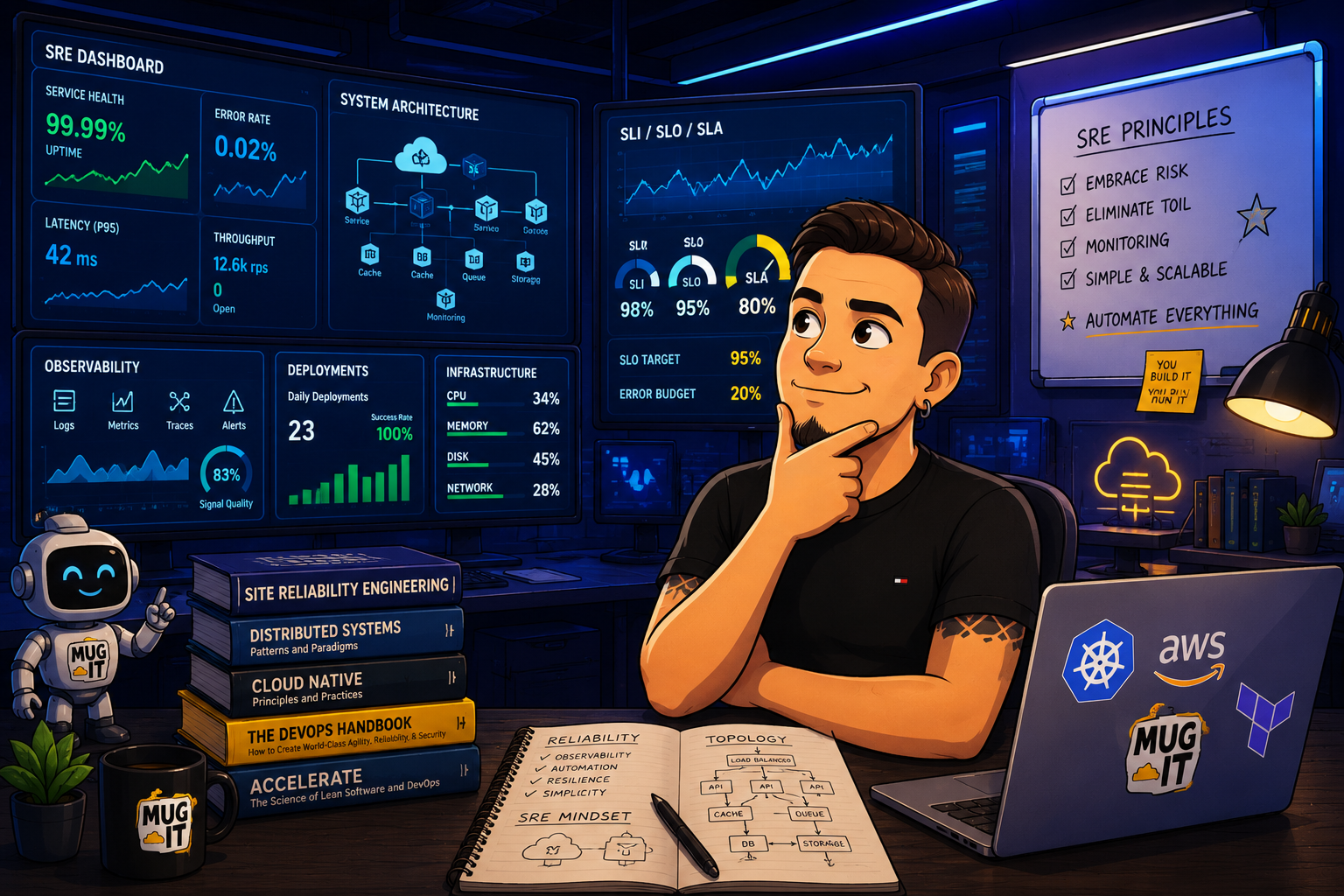
From an SRE perspective, this is exactly the profile that excels in production. An SRE isn’t expected to be the deepest expert or the best developer in the room. But they need to understand how systems interact, how failure propagates, where toil hides, and how reliability is owned — not by one team alone, but by the whole system.
Modern SREs are connectors of solutions, facilitators of decisions, and — increasingly — the people who know how to work with AI rather than compete against it.
Why Breadth Wins in Reliability Engineering
Let me make this concrete.
Picture a production incident: high latency on a payment service. A narrow specialist will see it through their own lens — the DBA suspects slow queries, the developer points to business logic, the infra team checks the load balancer. All of them are right. And all of them are wrong at the same time.
The engineer with breadth and SRE instincts does something different. They look at the four golden signals. They correlate metrics across layers. They check if the error budget is burning. They trace the request through infrastructure, service dependencies, and the application layer — and they find the bottleneck faster because they are not confined to a single domain.
This is why eliminating silos matters as much as eliminating toil. When knowledge is distributed and integrated, reliability improves. When it is hoarded in specialists who don’t communicate, incidents become longer, costlier, and more damaging.
I see the future with less severity-1 meetings with dozens of people replaced by a single person doing everything while using AI… at least the whole investigation and triage.. we still need other roles in incidents to help managing it and communicating with customers.
How AI Is Changing the Equation
Here’s the honest truth: AI is accelerating the abstraction of specializations.
What once required a full-time infrastructure engineer can now be handled by a generalist using the right AI tooling. What used to need a security specialist to review every config can be partially automated with policy-as-code and AI-assisted scanning.
This doesn’t eliminate the need for deep expertise. It shifts when that expertise becomes critical.
Specialists still matter — but at inflection points. When you’re designing the system at scale. When something unusual breaks in a way no tool anticipated. When you’re genuinely pushing the limits of a technology.
The rest of the time? The engineer who thinks systemically, navigates tooling across domains, and works well with AI is delivering more value per day than ever before.
What This Means for Your Career
The question isn’t “should I be a generalist or a specialist?”
The better question is: “Am I building depth where it matters, and breadth where it connects?”
A few practical moves worth considering:
- Understand your domain end-to-end. If you work in infra, learn enough about the applications you run. If you’re a developer, understand how your code behaves in production.
- Invest in observability. Knowing how to instrument, alert, and monitor makes you valuable in any technical role.
- Learn to use AI as a force multiplier. Not to replace your thinking — but to extend your reach across domains you don’t own deeply.
- Practice systems thinking. How does a change in one component ripple through the rest? This skill does not go obsolete.
Conclusion
The role of people working in technology is changing. And those who don’t change with it risk becoming that person who knew everything… about a world that no longer exists. (Don’t think you will lose the job — we still have well-paid positions for Mainframe, but demand has reduced and will reduce even more.)
The good news: you don’t have to choose one path permanently. But you do need to understand the game being played — and position yourself accordingly.
What drives reliability, resilience, and operational excellence isn’t deep knowledge in a single domain. It’s the ability to integrate knowledge across domains, adapt when the landscape shifts, and build systems — and teams — that survive uncertainty.
That’s what SRE has always been about.
That’s what I had for today.
See you next time 👋
Cheers,
Douglas Mugnos
MUGNOS-IT 🚀