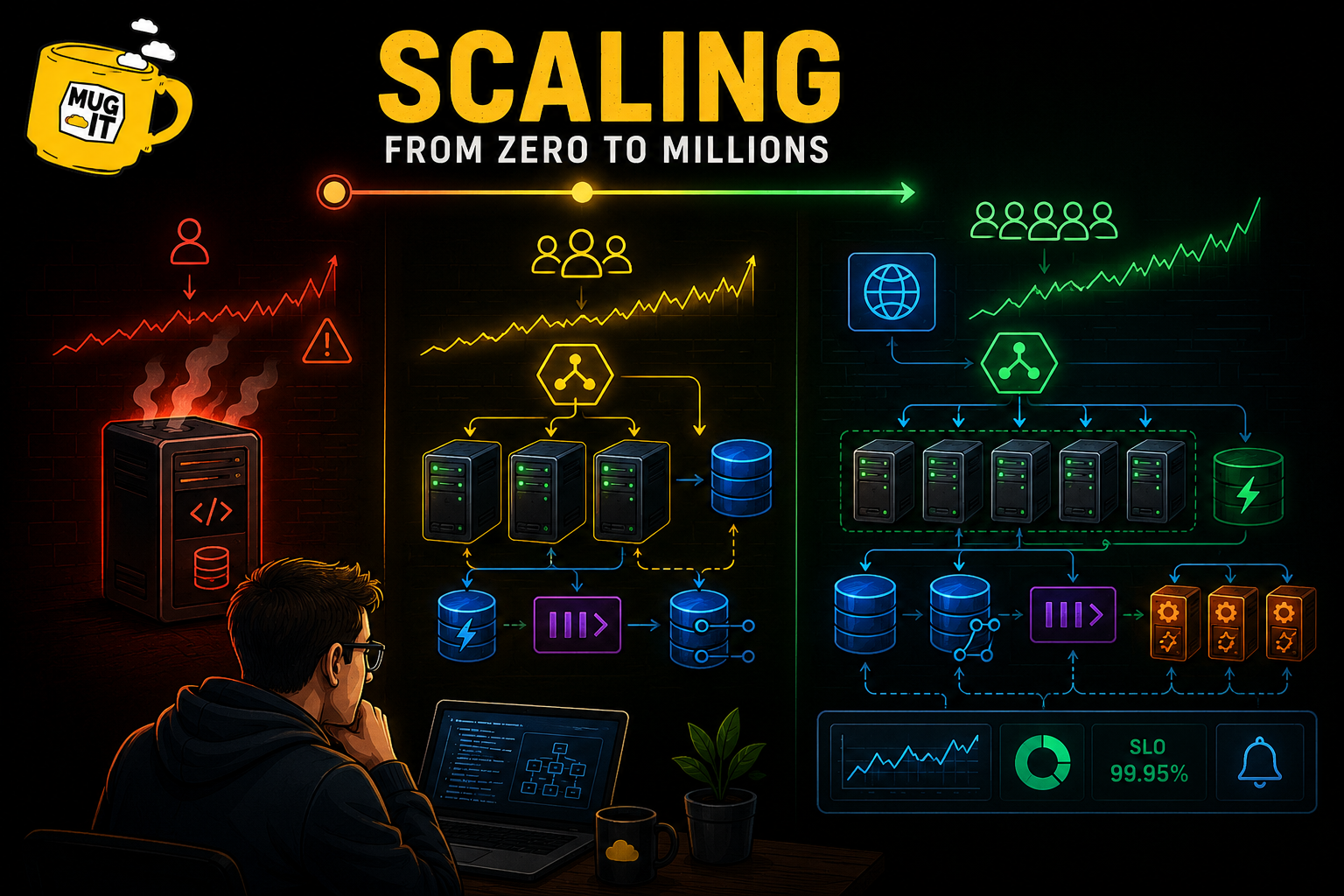
The Day Black Friday Started on a Monday
Picture the scene: Monday morning, the coffee just finished brewing, and your startup lands a huge partnership. Suddenly the traffic that used to be a low tide turns into a burst dam.
The main server — that brave warrior where the application code and the database shared the same “roof” — starts screaming for help. CPU pins at 100%. To make it worse, a scheduled automatic backup fires at the exact same moment, locking up the database queries. A customer tries to check out, the screen freezes on an infinite spinner, and they give up. The engineering Slack floods with alerts, and panic sets in.
Plenty of startups begin exactly like this: with a Single Server. It’s cheap, it’s simple, and it delivers value fast. But when the business scales, that lean architecture becomes your worst bottleneck.
The good news? You don’t need to (and shouldn’t) build a spaceship on day one. Here’s the survival roadmap to evolve your architecture, step by step, toward real scale.
1. Get the Database Out of the Application’s “House”
In a Single Server, the app and the database fight over the same CPU, memory, and disk, so a single heavy backup can destroy the end-user experience by freezing the whole system. Decouple the database: move it to a dedicated server or, better yet, to a managed service (like AWS RDS). This improves performance and isolates failures — though it doesn’t solve high availability on its own.
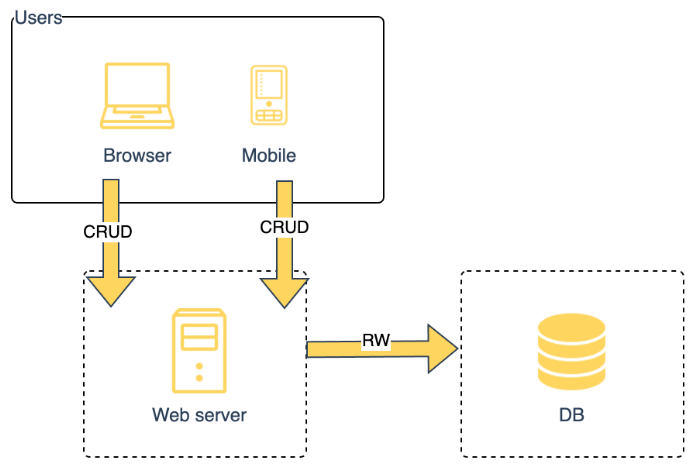
Single server: browser and mobile clients hitting one web server that reads and writes to a dedicated database.
2. Choose the “Size” of Your Scalability (Vertical vs. Horizontal)
Scaling vertically (Scale Up) means buying a bigger machine with more CPU and RAM; it works up to a point, but it has a physical ceiling, costs a lot, and requires downtime for upgrades. Scaling horizontally (Scale Out) is the real deal: you add identical servers working in parallel — divide and conquer. The catch is that to run horizontally your application must be stateless, so get rid of local state and move sessions and files to centralized stores.
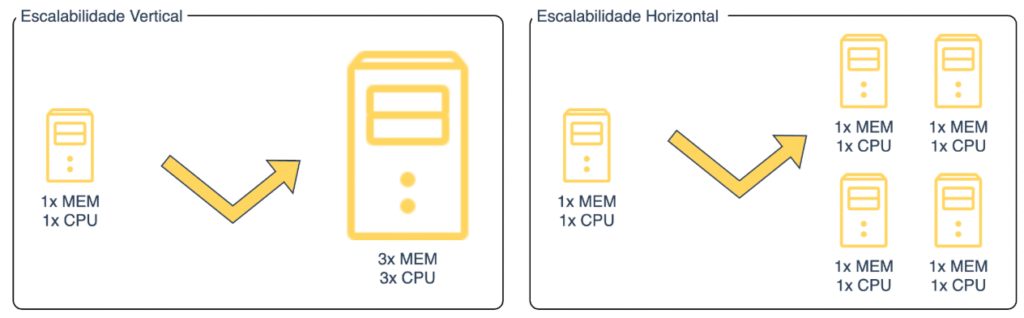
Vertical scaling grows one server to 3x CPU/RAM, while horizontal scaling adds four identical 1x CPU/RAM servers in parallel.
3. Introduce a Load Balancer
Once you have multiple servers, how do users know which IP to send the request to? Updating IPs directly in DNS is a headache, because the client cache (TTL) can take up to 24 hours to propagate. Put a Load Balancer in front of your servers instead: it provides a single, stable entry point and distributes traffic using algorithms like Round Robin. As a bonus, it adds security — it can block DDoS attacks and handle SSL certificate offloading.
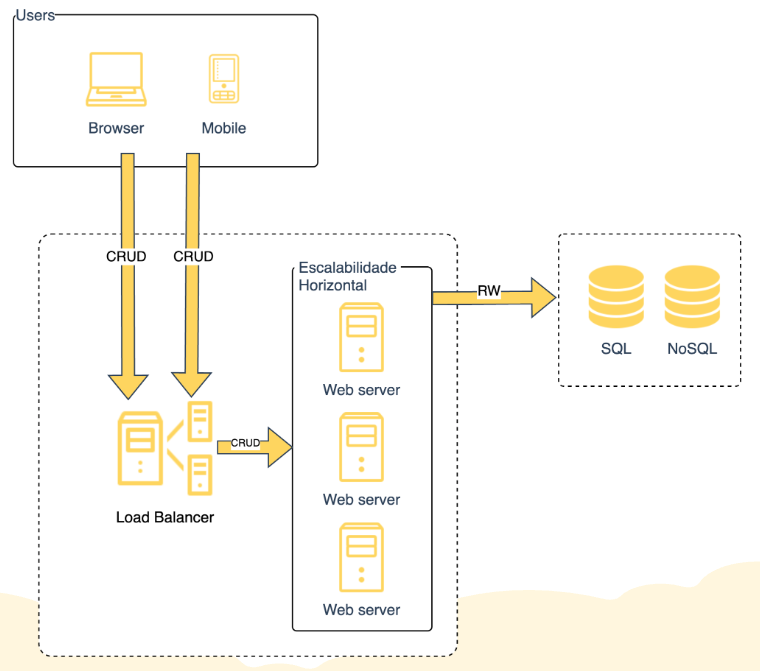
A load balancer sits in front of three horizontally scaled web servers, which read and write to SQL and NoSQL databases.
4. CQRS: Separate Writers from Readers
Implement database read replicas and use the CQRS pattern (Command Query Responsibility Segregation): writes go to the primary (Master) while reads go to the replicas. The tradeoff is that asynchronous replicas introduce a small delay (lag) — in most cases perfectly acceptable for the business, but you need to know where it isn’t.
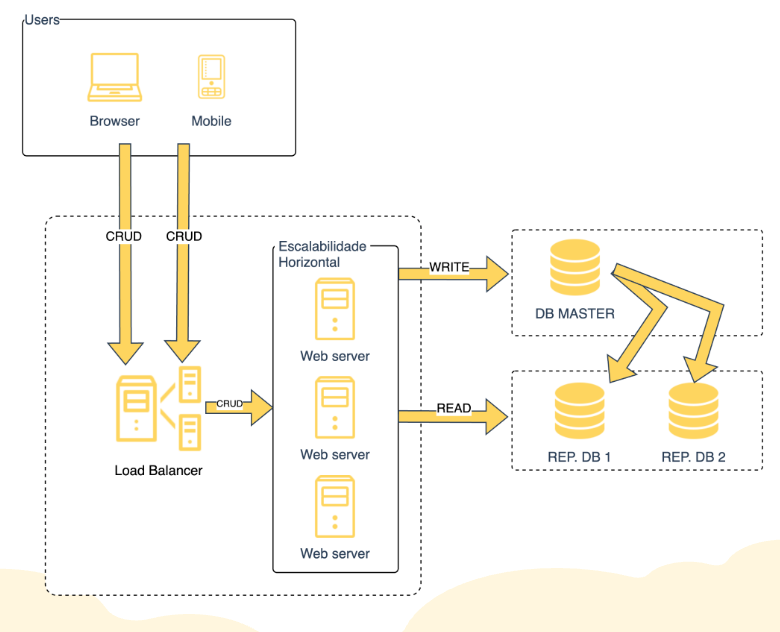
A DB Master handles writes and replicates to two read replicas that serve read traffic from the web servers.
5. Forget the One-Size-Fits-All Database
There’s no single database that fits everything — no one-size-fits-all. Combine a relational database (SQL) for structured profiles with non-relational databases (NoSQL) for product catalogs or logs.
When the relational database hits its ceiling, adopt Sharding (partitioning) to spread data from massive tables across multiple database servers.
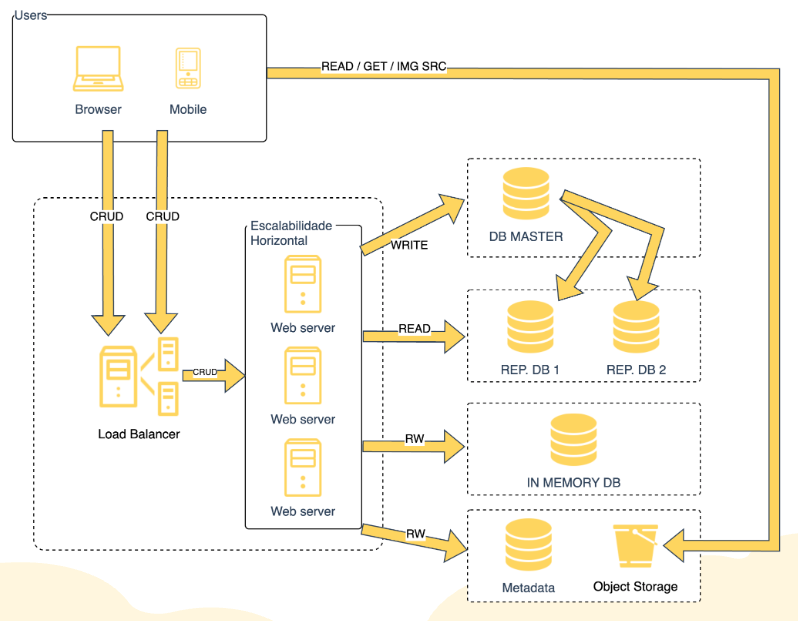
The web tier writes and reads across SQL replicas, an in-memory database, and metadata plus object storage.
6. CDNs and Caches Are Life Optimizers
Don’t overload your primary database fetching repetitive data (like popular search terms). Use in-memory caches (Redis, Memcached) to cut query latency from 200ms down to 20ms.
Decouple static files (images, videos) by moving them to Object Storage (like S3) and serve them through a CDN, placing the files physically closer to the end user.
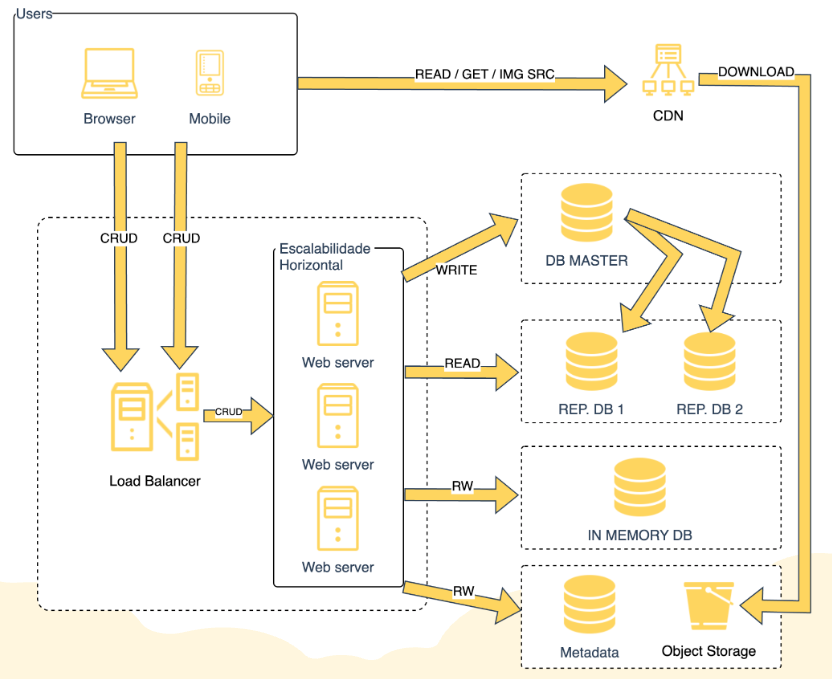
Clients download static assets from a CDN, which pulls from object storage, offloading the origin servers.
7. Embrace Asynchrony with Message Queues
Don’t do everything in real time if the user doesn’t need the answer right now.
In flows like payments, instead of processing everything synchronously while the user waits, save the intent to a message queue, respond with a quick “Thanks, we’re processing”, and let background workers complete the transaction. If the payment gateway goes down, nothing is lost: the transactions stay safely in the queue until the system recovers.
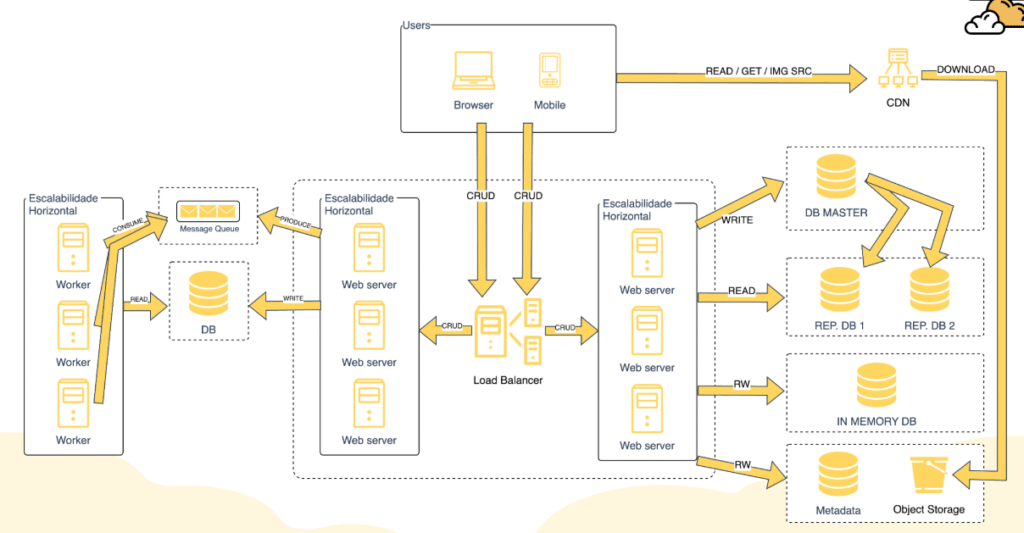
Web servers publish to a message queue that background workers consume to process transactions asynchronously.
8. Defend Observability Tooth and Nail
A distributed architecture without centralized logs, metrics, and traces is a complete nightmare. You need to trace the journey of a request as it flows through multiple services to understand exactly where a failure happened.
And here the SRE connection is direct: scale your decisions guided by SLOs. Alert on error-budget burn rate (“I’m spending this month’s budget in 2 hours”), not on absolute CPU values. That’s what turns data into decisions.
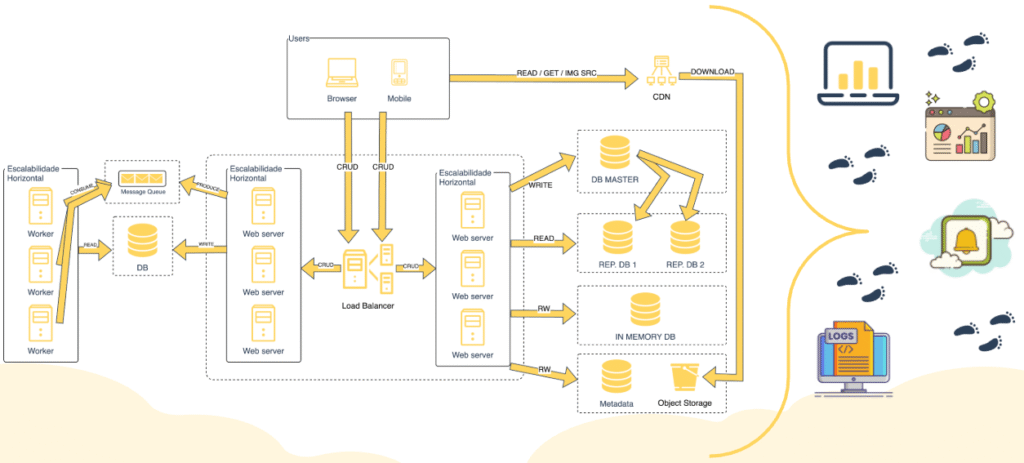
The full distributed architecture wrapped by an observability layer of dashboards, metrics, alerting, and centralized logs.
🧠 Why This Conscious Evolution Matters
The biggest lesson from studying the journey from 0 to 1 million users is that great architecture is born from pragmatism and balance, not from trendy technologies.
Two principles should be your spiritual guides: KISS (Keep It Simple, Stupid) and YAGNI (You Aren’t Gonna Need It). Adding microservices, distributed caching, and sharding on day 1 of a startup with no users isn’t genius — it’s a waste of time, money, and focus.
The real job of the architect and the SRE is to know the tools, understand the tradeoffs of each decision, and know exactly when to apply each piece of the puzzle. And, crucially: document your decisions with ADRs (Architecture Decision Records). The tradeoffs you choose today will come due in the next 6 months — make sure the reasons are recorded so leadership and the team remember the plan.
Start simple, monitor behavior, and scale only when the real need knocks on your door.
📊 We want to hear from you: Has your team ever hit an outage or slowdown that one of these strategies could have prevented — a database freezing during a backup, a single server maxing out under a traffic spike, replica lag serving stale data, or a payment lost because there was no queue to catch it? Reply to this newsletter with your war story — let us know!
Want to go deeper on scalable architecture and SRE practices? Keep an eye on upcoming content and training at mugnos-it.com.
Cheers,
Douglas Mugnos
MUGNOS-IT 🚀