Today, I want to talk about something different. Something we’re all experiencing, but especially those of us working in technology.
We’re witnessing something incredible. And, in many ways, we’re the guinea pigs of this transformation.
As technology professionals, we’re among the people using AI the most. We’re experimenting, adopting, building, and discovering what these tools can do, often before the rest of the world.
But something interesting is happening.
We’re Accelerating Everything. Including the Information We Need to Absorb.
Think about how things worked before. Building and maintaining software already required an enormous amount of knowledge: deep expertise in specific technologies, frameworks, programming languages, infrastructure, and tools.
And then AI changed the game.
Imagine you’re building an application using Kubernetes on AWS, writing code in Go, integrating multiple services, and relying on dozens of other technologies. Today, AI helps you develop that application faster. It helps you design your infrastructure, troubleshoot problems, write code, and understand technologies you might not have mastered before.
Amazing, right? But here’s the catch.
You’re not the only one accelerating. Everyone else is, too.
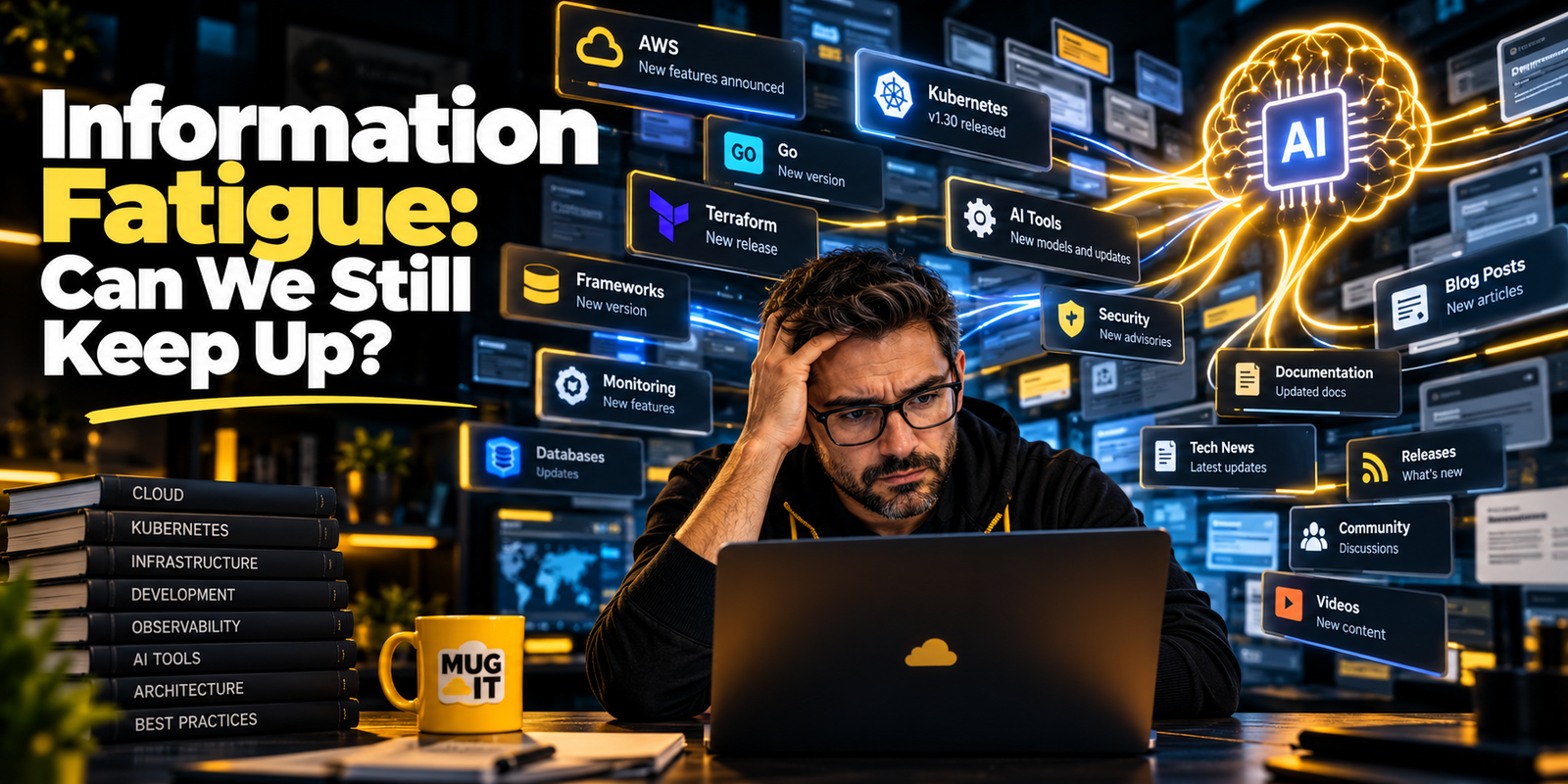
AWS is evolving faster. Frameworks are evolving faster. Development tools, infrastructure platforms, libraries, and virtually every technology you depend on are evolving faster. Every week, there’s something new.
And suddenly, we’re caught in an endless cycle of information.
First, We Couldn’t Review All the Code. Now, Can We Keep Up With All the Knowledge?
Just a few months ago, AI became incredibly effective at generating code. We started discussing vibe coding, AI-assisted development, and a fascinating problem: humans could no longer realistically review every line of code being generated.
So what did we do? We started using AI to review code generated by AI. Funny, isn’t it?
At the same time, the industry reinforced something I’ve been advocating for years in my courses and articles: the importance of being a generalist. Strong technical breadth became increasingly valuable. AI was making it possible to work across different technologies without being a deep specialist in every single one.
But now I’m starting to question something.
What happens when the amount of information being generated and accelerated by AI becomes too much for even a generalist to follow?
How do we maintain that breadth of knowledge? How do we stay informed about the technologies we use when everything is changing simultaneously?
And perhaps the more uncomfortable question:
What if AI becomes better at being a generalist than we are?
Where Do We Fit Into All of This?
As SREs, infrastructure engineers, software developers, and technology professionals, we’re facing real uncertainty about what comes next.
I’m not questioning whether AI is valuable. Its impact is undeniable. I’m questioning our ability to keep up with the world AI is helping create.
For years, being a generalist meant understanding the bigger picture, connecting different technologies, and keeping enough knowledge across multiple domains to make informed decisions. I still believe that matters. But how sustainable is it?
If every tool, platform, framework, and service we depend on is changing faster than ever, how much of that evolution can we realistically follow? And if we can’t keep up, how do we remain relevant?
Maybe the challenge is no longer just learning faster. Maybe it’s learning how to decide what deserves our attention in the first place.
An SRE Lens: This Is an Alerting Problem 🔧
As SREs, we’ve solved a version of this before. When every metric fires an alert, the on-call engineer drowns in noise and misses the signal that matters. The fix was never “read alerts faster.” It was alerting only on what affects users, and accepting that the rest goes unseen.
Information works the same way. A release note for a tool you don’t run is noise. A breaking change in the Kubernetes version you’re about to upgrade to is a page.
And every dependency you add isn’t just operational risk. It’s also another stream of information you’ve signed up to follow. That’s too much noise, and too much noise eventually leads to information fatigue.
Now I Want to Hear From You
This newsletter is a little different from my usual posts. I’m not here to introduce another technology, recommend another tool, or explain another AI concept.
Instead, I want to understand how you’re dealing with this information avalanche.
How are you keeping yourself up to date?
- Are you using specific tools to organize and filter information?
- Have you built automations or AI agents to monitor blogs, documentation, and technology updates?
- Are you relying on AI to summarize what matters across the technologies you work with?
- Or are you simply jumping from one topic to another, trying to keep up with everything?
I’ve been thinking a lot about this challenge and rethinking how I personally consume and organize technical information. But I’m much more interested in learning what works for you.
Reply to this email and tell me how you’re handling it. I suspect many of us are facing the same problem, even if we haven’t stopped to talk about it. I’ll share the best approaches in a future newsletter.
And maybe the most important question isn’t how much more we can learn.
It’s how we can stay relevant in a world that’s evolving faster than we can follow.
Cheers,
Douglas Mugnos
MUGNOS-IT 🚀