I’ve had the chance to help shape architectural decisions for a lot of critical applications, some of them running a few hundred TPS. And one question shows up in almost every one of those conversations, often before we even talk about language, database, or infrastructure: “are the components of my architecture going to be single-tenant or multi-tenant?”
The answer, like almost everything in architecture, depends. But understanding the impact of each choice can save you a lot of money, a lot of operational pain, and can even help you hit more aggressive SLAs.
Before anything else, let’s align on terms:
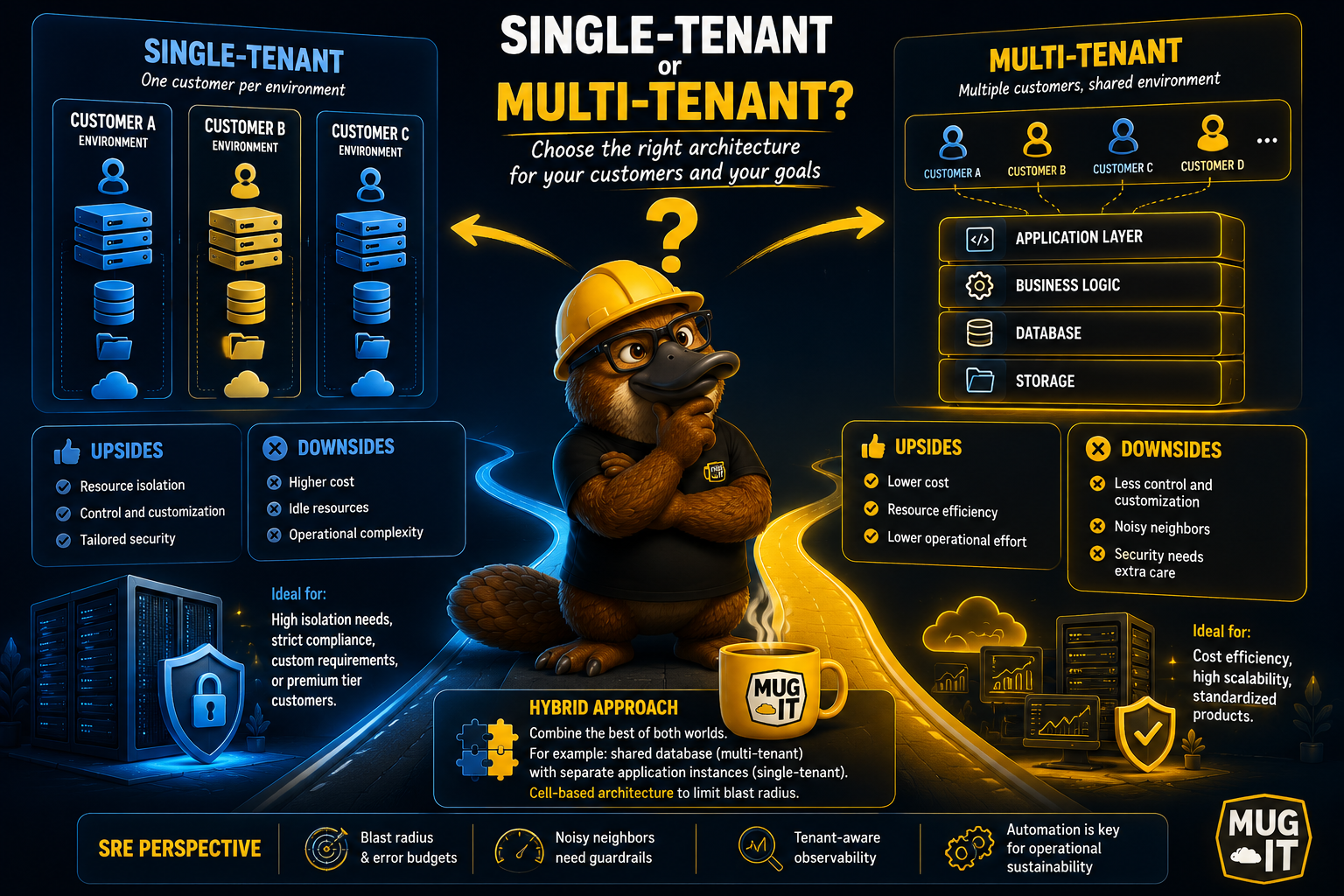
- Single-Tenant = one customer per environment (everything dedicated).
- Multi-Tenant = multiple customers sharing the same environment (application, database, etc.).
What’s the practical difference between them?
Picture a SaaS product serving dozens or hundreds of customers. You can go two ways.
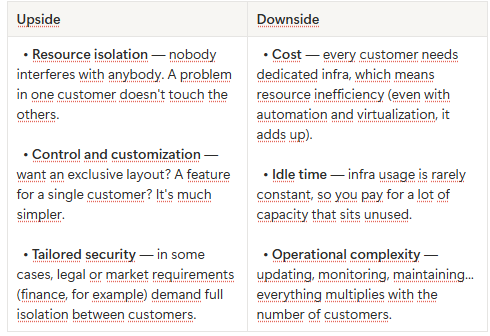
Single-Tenant: each customer gets their own application, database, pipelines, and storage. Everything is dedicated.
Multi-Tenant: all customers share the same components, separated by logical rules and segregation.
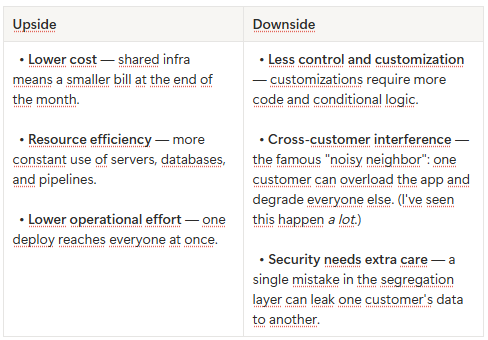
And if I want to mix them?
You can, and in many cases you should. For example: a shared database (multi-tenant) with separate application instances (single-tenant). Or the inverse. A group of your most critical customers can get a dedicated environment, while the rest share the same infra.
This hybrid model solves a lot of problems without paying the high price of full isolation for everyone. It’s the same instinct behind a cell-based architecture: partition customers into independent cells so the blast radius of any failure is contained to a subset of tenants, not the whole fleet.
The SRE angle: this is a reliability decision, not just a cost one
Here’s what often gets missed in these conversations: tenancy is a reliability decision as much as a cost one.
Blast radius and error budgets. In multi-tenant, one bad deploy burns the error budget for every customer simultaneously. In single-tenant, a failure is contained to one tenant. If you have customers with very different reliability expectations, a hybrid model lets you give your premium tier its own error budget instead of averaging everyone’s pain together.
Noisy neighbors need real guardrails. If you go multi-tenant, the noisy-neighbor problem isn’t hypothetical, it’s a Tuesday. You need per-tenant rate limiting, quotas, and resource caps from day one. Treat it as a design requirement, not an incident you’ll handle later:
Per-tenant guardrails in a multi-tenant service
tenant_limits:
default:
requests_per_second: 200
max_db_connections: 20
max_concurrent_jobs: 10
premium_tenant_42: # isolate the whale before it sinks the boat
requests_per_second: 2000
max_db_connections: 100
Observability has to be tenant-aware. In multi-tenant, an aggregate dashboard will happily show “99.95% availability” while one specific customer is having an outage. Tag your metrics, logs, and traces with tenant_id so you can measure per-tenant SLIs, not just fleet-wide averages. Otherwise your SLOs are hiding exactly the failures your customers care about most.
Toil scales with your topology. Single-tenant multiplies operational toil: N environments to patch, monitor, and upgrade. If you go that route, automation isn’t optional, it’s the only thing that keeps the model sustainable. Your deploy, provisioning, and monitoring have to be fully templated and repeatable, or the operational cost will quietly eat the isolation benefit you were paying for.
Conclusion
The choice between single-tenant and multi-tenant is less about taste and more about context. Weigh:
- Number of customers and expected growth
- Security and compliance requirements
- Level of customization needed
- The cost efficiency you need to reach
- Your operational capacity (time, automation, observability)
And remember the reliability lens: how much blast radius can you tolerate, and can your monitoring actually see problems at the tenant level? Get those two right and the rest of the decision gets a lot clearer.
This is just one of the many decisions we face day to day working with applications and infrastructure. If you enjoy this kind of content, with real context, honest comparisons, and no hand-waving, keep watching for next newsletters.
Cheers,
Douglas Mugnos
MUGNOS-IT 🚀